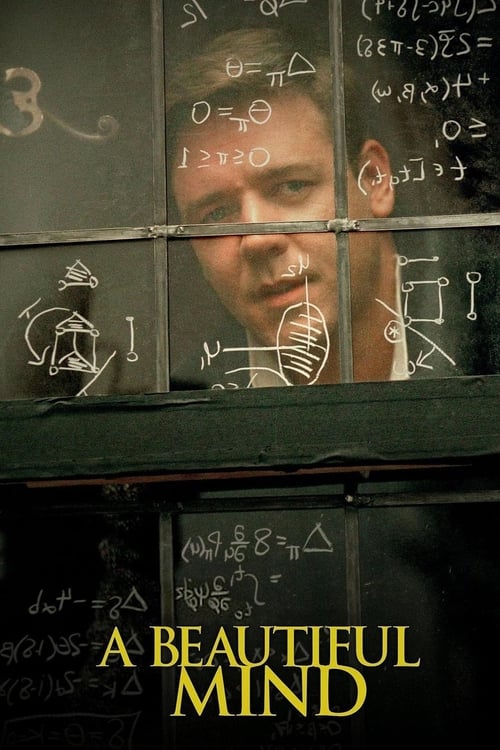
A Beautiful Mind (2001)
When Love Anchors a Mind Coming Apart
by 10days1movie · Published 2026-09-05
| Type | Movie |
|---|---|
| Director | Ron Howard |
| Cast | Russell Crowe, Jennifer Connelly, Ed Harris, Paul Bettany, Christopher Plummer, Adam Goldberg |
| Release | 2001 |
| Genre | Drama, Romance |
| Runtime | 135min |
What does the inside of a genius’s mind look like? A Beautiful Mind answers that question not with dazzling equations but with loneliness. Adapted from the life of the real mathematician John Nash, the film traces how extraordinary talent and mental illness become tangled inside a single person. And at the end of that turmoil, it quietly shows us what it was that saved one human being. My rating is ★4.0.
What it’s about — Not a genius’s glory but a war with illness
In the late 1940s, Nash (Russell Crowe) arrives at Princeton as an ambitious young man hungry for an original theory no one else has cracked. Socially awkward and arrogant, his mathematical intuition is nonetheless uncanny. He eventually produces a theory that shakes academia and earns his name, but he also begins to believe he has been pulled into a secret government codebreaking assignment. The film slowly reveals how much of the world he saw was ever real, keeping its focus not on the genius’s triumphs but on the illness he would fight for the rest of his life.
Direction — A device that traps the viewer in Nash’s point of view
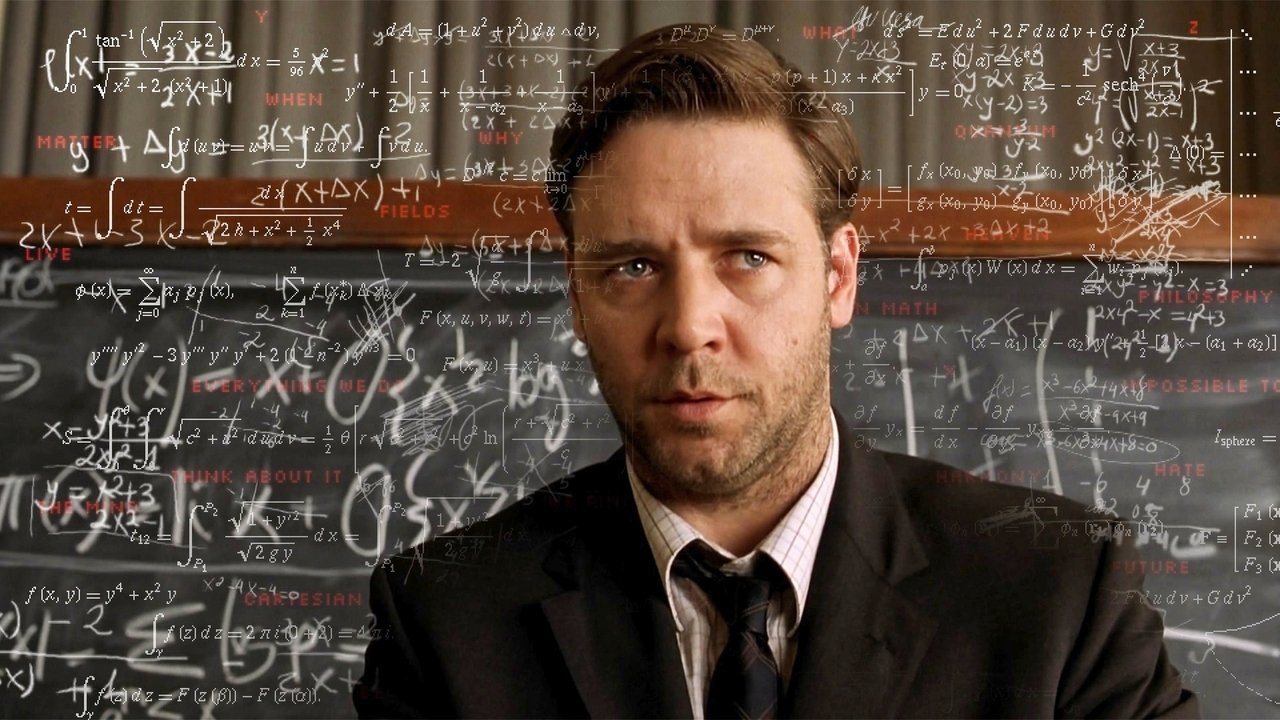
The cleverest choice in Ron Howard’s direction is the way he locks the audience into Nash’s perspective. At first, the film refuses to tell us what is real and what is hallucination. As a result, we experience Nash’s confusion exactly as he does, and when the truth is finally revealed, we absorb the same shock he must have felt. The device works because it makes us live mental illness rather than have it explained to us. The dramatic streamlining of the true story does flatten some facts, and that is a fair complaint. Even so, Howard restrains the lurid touches and trains his eye on the interior of his characters and the relationships around them. That warmth of attention is what protects the film’s dignity.
Performance — A restrained transformation that spans decades
Russell Crowe convincingly renders one man’s change across several decades. From the arrogant young prodigy to the middle-aged man with trembling hands and wavering eyes who battles his illness, Crowe alters both his physicality and his bearing to build Nash into a fully dimensional figure. His performance, restrained and free of exaggeration, makes the character’s suffering feel all the more true. Jennifer Connelly holds up the film’s other axis as Nash’s wife, Alicia. She gives depth to the patience and love of a woman trying not to break while standing beside her brilliant husband, and she won the Academy Award for Best Supporting Actress for it. Paul Bettany also leaves a strong impression in a pivotal role.

What the film says — Not erasure but learning to coexist
The real subject of A Beautiful Mind is not mathematics but love and will. Nash never fully banishes the hallucinations. Instead, he learns to live alongside them. Deciding for himself which voices to trust and which to ignore is the greatest insight he gains over a lifetime. And at his side was a wife who never left. The film conveys, plainly but movingly, that a problem reason cannot solve is ultimately held together by the heart. The final scene, in which an elderly Nash quietly reflects on his life before a lecture hall packed with students, lands with more resonance than any flashy acceptance speech. He never completely defeated the phantoms that tormented him his whole life, but by learning not to be ruled by them, he returned to the world. That perspective, that recovery is not total erasure but the practice of coexistence, is what makes the film so deeply human.
Ratings & reception
The film was both a commercial and a critical success. Its IMDb rating is a high 8.2, the Rotten Tomatoes Tomatometer sits at 74 percent, and the Metacritic score is 72. At the Academy Awards it won four categories, Best Picture, Best Director, Best Supporting Actress, and Best Adapted Screenplay, making it the night’s headliner. There were complaints that the true story had been dramatized rather freely, but praise for the performances and the emotional resonance overwhelmed them.
Verdict
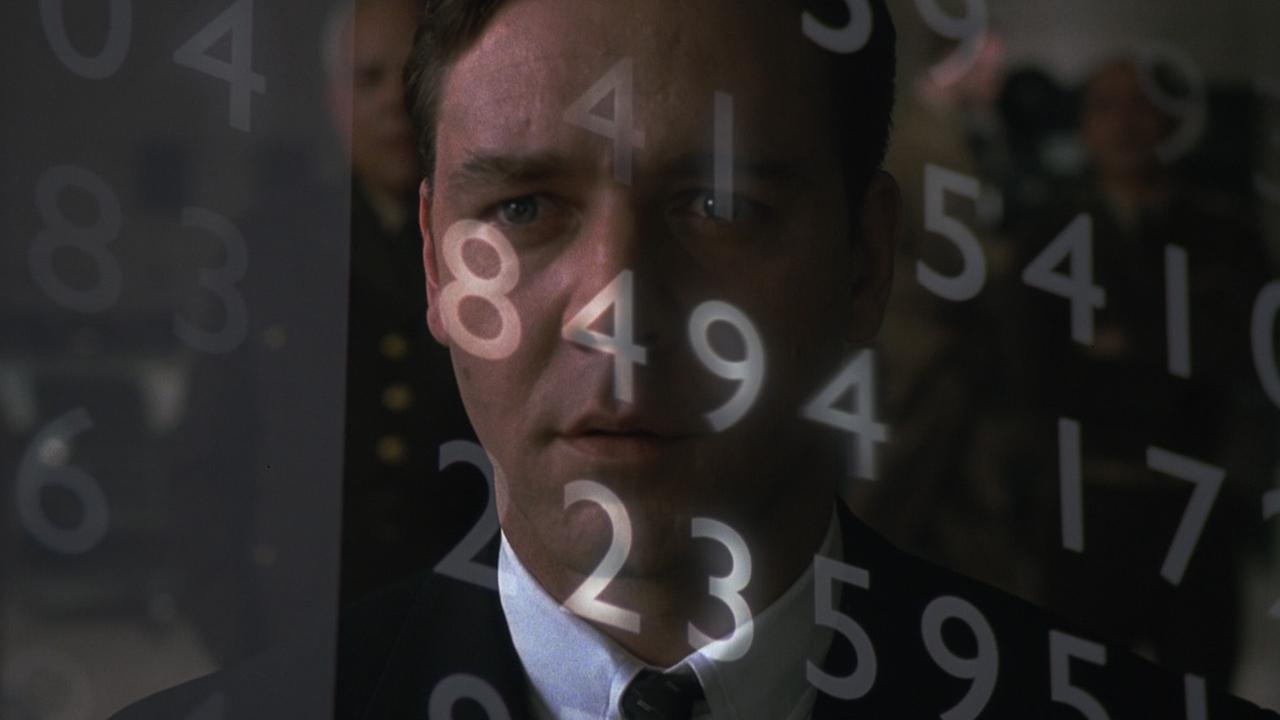
Rather than painting a myth of genius, A Beautiful Mind honestly follows the process by which one human being makes peace with his illness. There are moments where the limits of true-story adaptation show, but the performances of Russell Crowe and Jennifer Connelly, along with the moving instant when love anchors a mind, comfortably clear those limits. ★4.0 is a rating this film fully earns.
Recommended for
- Viewers who love moving dramas rooted in true stories
- Anyone who wants to see deep, layered acting
- Those looking for a film that treats mental illness with a warm gaze
Comments