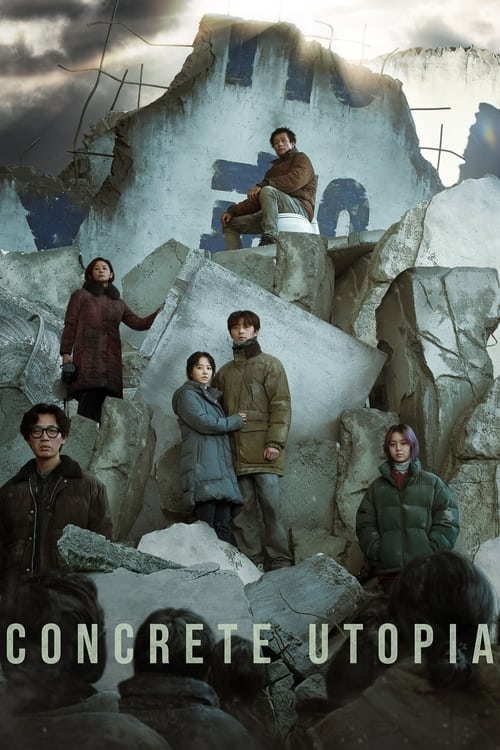
Concrete Utopia (2023)
One apartment block left standing in a collapsed city
by 10days1movie · Published 2026-11-10
| Type | Movie |
|---|---|
| Director | Um Tae-hwa |
| Cast | Lee Byung-hun, Park Seo-jun, Park Bo-young |
| Release | 2023 |
| Genre | Thriller, Action, Drama |
| Runtime | 130min |
After a massive earthquake levels everything, a single apartment block stands intact. Concrete Utopia builds a miniature of human society out of this simple yet powerful premise alone. Director Um Tae-hwa borrows the exterior of a disaster film, but where the camera actually turns is not the collapsed building but the hearts of the survivors. It coldly examines how a community degenerates in the face of the desperation of survival. The chill of that gaze is impressive, yet the bluntness of the ending dilutes its resonance, so the rating left in my hand is ★3.5.
What it’s about — The rules of those who survived
Amid an unprecedented earthquake that reduces all of Seoul to ruins, only the Hwanggung Apartments remain standing. As outside survivors driven by cold and hunger flood in, the residents begin to set up rules so that only the registered tenants survive. At the center of this is Yeong-tak (Lee Byung-hun), who becomes the residents’ representative by chance. The couple of Min-seong (Park Seo-jun), a former civil servant, and Myeong-hwa (Park Bo-young), a nurse, are each shaken in different ways within that order. The film follows, from a step removed, the process by which the cause of protecting safety gradually turns into exclusion and violence.

Direction — A single point amid the ruins, the apartment
Um Tae-hwa’s direction uses space very cleverly. The apartment rising alone in the middle of ruined Seoul becomes a powerful symbol in itself. The concrete wall dividing inside from outside, us from them, works as an axis of tension throughout the film. The art and visual effects depicting the collapsed city are polished enough to be said to have raised the bar for Korean cinema a notch. That said, as it moves into the back half there are moments where it reveals its message rather directly, so you may feel the conclusion runs ahead of the resonance. Even so, the craft of handling the texture of ruins and the characters’ movement is solid.
Performance — A film Lee Byung-hun grips and shakes
This film is worth watching for Lee Byung-hun’s performance alone. He chillingly renders the process by which a man who was plain to the point of shabby changes as he grasps power. His acting, swinging between the comical and the sinister, freely shifts the film’s texture. Park Seo-jun persuasively expresses an ordinary breadwinner crumbling between decency and cowardice, and Park Bo-young holds the film’s ethical center as a character who refuses to let go of her humanity to the end. The differently textured performances of the three actors add dimension to the film.

What the film says — The end of the desire for “my home”
The real subject of Concrete Utopia is not disaster but ownership. The film takes precise aim at the reality that in Korean society the apartment has become a symbol of status, safety, and self-worth beyond mere living space. The process by which rules set up to survive turn at some point into violence that excludes someone reminds us that any ordinary person could stand in that place. The film shows clearly, without needing to raise its voice, that the wish to protect what is mine and the wish to push others out spring from the same root. That is why the title “Utopia” sounds colder and colder.
Ratings & reception
The IMDb score is 6.6, the Rotten Tomatoes freshness is 100%, and the Metacritic score is 73. Its attempt to combine a social fable with the Korean disaster genre was well received overseas as well, and it was counted among the films representing Korean cinema that year. Many feel it holds both genre entertainment and a weighty thematic awareness at once.

Verdict
Concrete Utopia is both a well-made Korean disaster drama and a sharp social fable. The film’s heart lies in its gaze on the human being after the disaster rather than the disaster itself, and Lee Byung-hun powerfully supports that gaze. The somewhat clearly revealed message may be a shame, but the polished art and the actors’ performances amply cover it. It is worth recommending to viewers who want to see both the spectacle of disaster and the drama of human nature.
Recommended for
- Those who enjoy ensemble dramas of human nature set against disaster
- Those who want to see Lee Byung-hun’s intense performance
- Those interested in allegorical stories that reflect Korean society
Comments