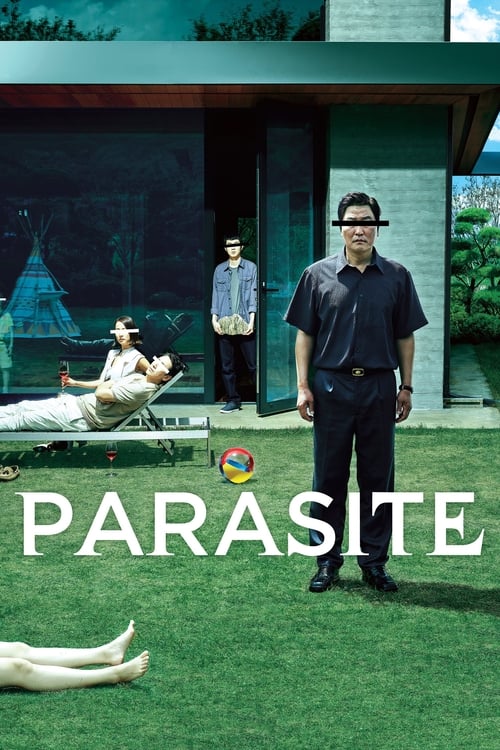
Parasite (2019)
Above and Below the Stairs, Korean Society in Between
by 10days1movie · Published 2026-06-14
| Type | Movie |
|---|---|
| Director | Bong Joon-ho |
| Cast | Song Kang-ho, Lee Sun-kyun, Cho Yeo-jeong |
| Release | 2019 |
| Genre | Comedy, Thriller, Drama |
| Runtime | 131min |
When the film ended, I couldn’t get up for a while. A structure that you think is a comedy, then becomes a thriller, then ends as tragedy — one that never permits a prediction from beginning to end. Bong Joon-ho’s Parasite is a singular work that no single genre label fits neatly. Rating: ★4.5.
What it’s about — A semi-basement family’s infiltration play
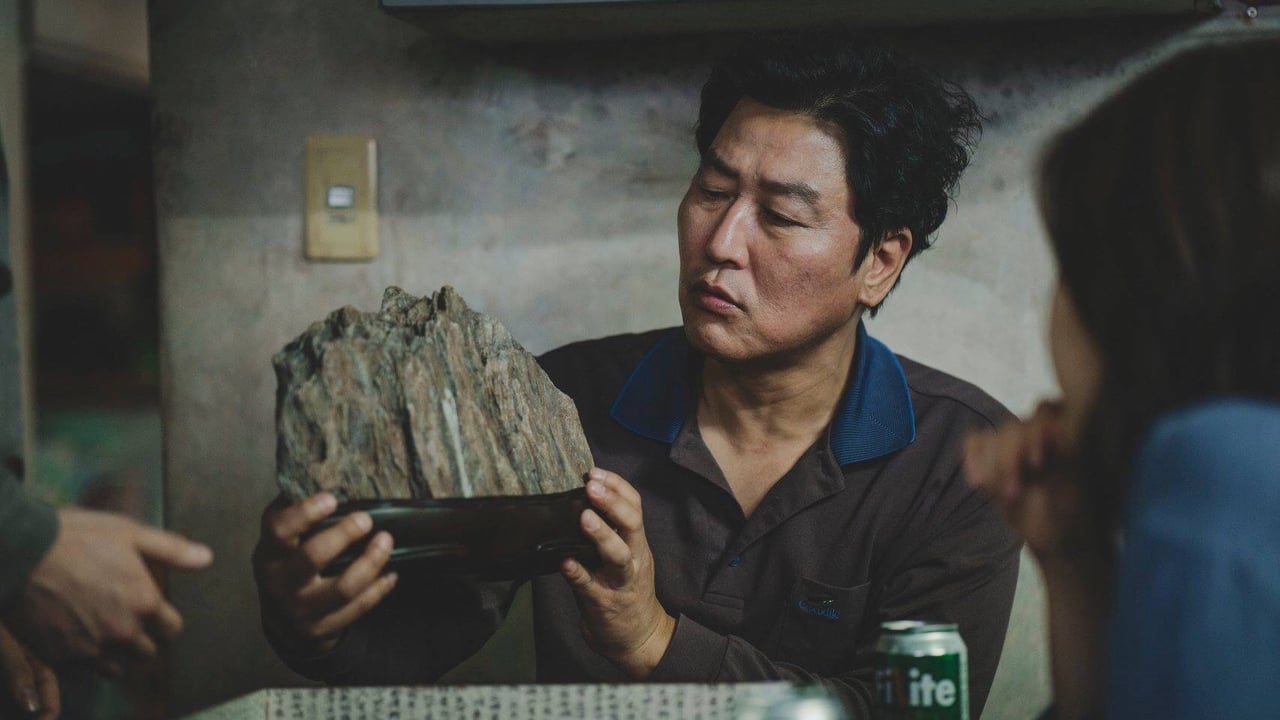
The Kim family — father Ki-taek (Song Kang-ho), mother, son Ki-woo, and daughter Ki-jung — live in a semi-basement apartment. One day Ki-woo lands a tutoring job at the wealthy Park household, and the story begins. He gradually places his family members inside the house one by one. The Park family (Lee Sun-kyun, Cho Yeo-jeong) notices nothing. Then an unforeseen incident occurs and the story explodes in an entirely different direction. What comes after contains spoilers, but in the second half, the film changes genre entirely.
Direction — Space written as the language of class
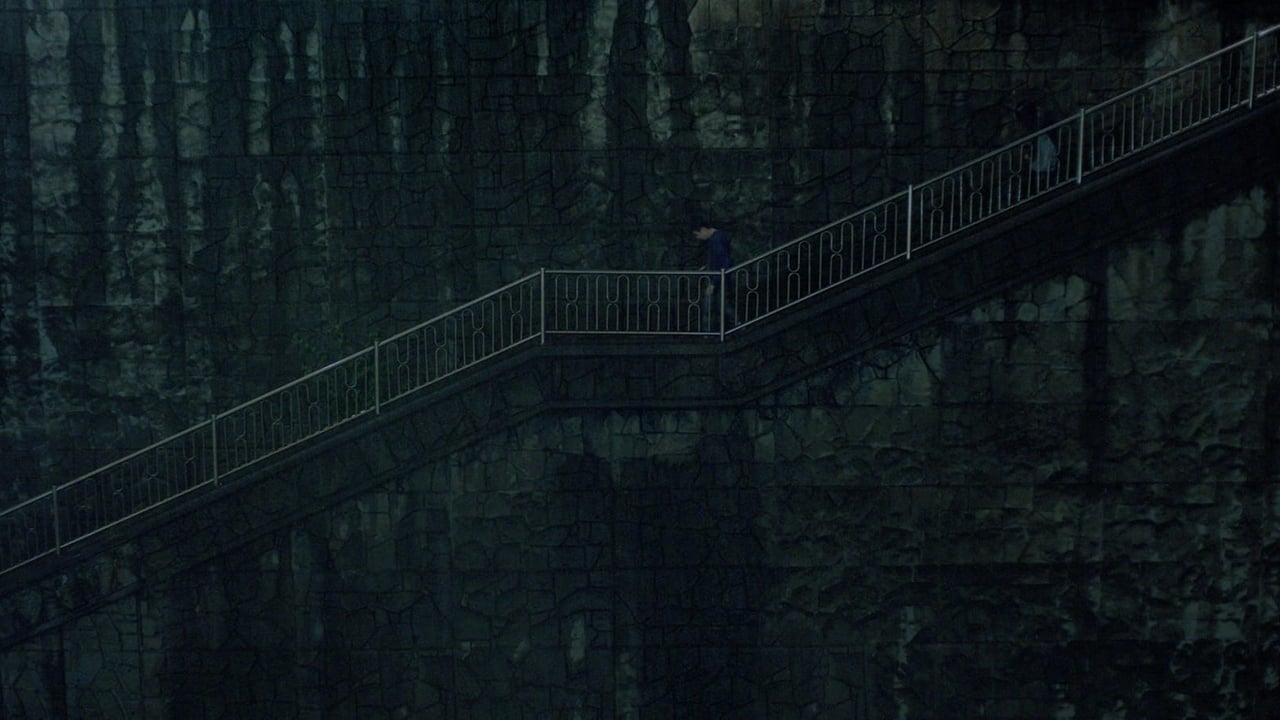
Bong Joon-ho uses space as the language of class. The Kim family’s semi-basement apartment, the Park family’s elevated hilltop mansion, and the further space that exists beneath it. The directions that up and down, stairs, and rainwater flow all function as symbols. Just watching how the characters move between these spaces is enough to read the film’s themes.
The smoothness of the genre transition is also remarkable. It starts as comedy, shifts into thriller as tension builds, and leaves a heavy resonance at the end. Not a single scene is wasted. The rainy night sequence is one of the most overwhelming in the entire film, transmitting complex emotions as physical shock.
The music by Jung Jae-il, dominated by piano, and Hong Kyung-pyo’s cinematography both contribute to completing the film’s mise-en-scène. The film is so deliberately designed that watching it a second time reveals things invisible the first time.
Performance — The shabbiness and the eruption Song Kang-ho holds
Song Kang-ho is Korean cinema’s most reliable actor. Ki-taek is a complex figure. He lies to survive — yet you can’t simply condemn him for it. Song Kang-ho contains Ki-taek’s shabbiness and warmth, and whatever explodes in the final act, all at once. Cho Yeo-jeong’s naïve portrayal of the mistress, Lee Sun-kyun’s well-meaning but oblivious employer — both avoid reducing their characters to types, giving their roles genuine life.
What the film says — The class line drawn by smell
The way Parasite addresses class is not simplistic. There are no villains. The Park family is kind but oblivious; the Kim family is not entirely good, but understandable. The film neither condemns this structure nor offers a solution. Ki-taek’s line about “a life without a plan” resonates meaningfully at the end because of the gap between those who cannot make plans and those who don’t need to. The film shows us, quietly but shockingly, where that gap comes from.
The motif of smell is also worth noting. Smell functions as the border of class — the language of a discrimination that never becomes visible. It can’t be washed off, and the smell that comes from the semi-basement apartment doesn’t leave the tip of Mr. Park’s nose, no matter how much he tries not to mind it.
Ratings & reception
Parasite won the Palme d’Or at the 2019 Cannes Film Festival, then became the first non-English language film to win Best Picture at the Academy Awards. It also took Best Director, Best Original Screenplay, and Best International Feature Film — four wins in total. TMDB score is 8.5, IMDb score is 8.5, Rotten Tomatoes freshness is 99%. Critical reception was nearly unanimous. The film stands as the work that announced Korean cinema’s arrival at the mainstream of world cinema.

What doesn’t quite work
The mid-film shift in tone may feel too abrupt for some viewers. Even if you understand that the film is deliberately moving genres, the gap between the clever comedy of the first half and the violence of the second half can feel jarring. The final letter and the imagined ending are also ambiguous as to whether they represent a hopeful conclusion or a bitter irony — an intentional choice, but one that may leave viewers who want clear catharsis unsatisfied.
Verdict
Parasite is clever, shocking, and lasting. Few works have handled the heavy themes of class and inequality with this level of entertainment and seriousness simultaneously. I believe this is the film in which Bong Joon-ho’s abilities are displayed at their fullest. There’s a reason the world paid attention. Rating: ★4.5.
Recommended for
- People interested in original Korean films that transcend genre
- Viewers who enjoy stories about class and social structure
- Those who love unpredictable narratives
- Anyone who has watched other Bong Joon-ho films and wants more
Comments