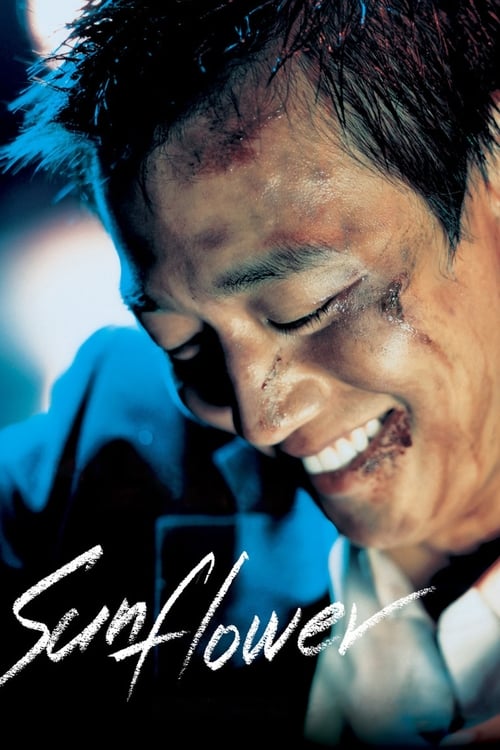
Sunflower (2006)
One Man's Struggle to Break Free of Violence
by 10days1movie · Published 2026-10-20
| Type | Movie |
|---|---|
| Director | Kang Seok-beom |
| Cast | Kim Rae-won, Kim Hae-sook, Heo Yi-jae, Kim Byeong-ok, Kim Jeong-tae, Han Jeong-su |
| Release | 2006 |
| Genre | Crime, Drama |
| Runtime | 116min |
Never again will I hit anyone. The film begins with this resolution, written in a notebook by a man about to be released from prison. Sunflower is a work that tenaciously observes how the world pulls a man who has lived by violence back in when he tries to break free of it. Watch it expecting flashy action and it is unexpectedly quiet, and that quietness makes the eruption of the second half hurt all the more.
What it’s about — A vow never to hit again
Oh Tae-sik (Kim Rae-won) was once a fighter no one could touch. Returning to his hometown after ten years in prison, he relearns an ordinary daily life beside Yang Deok-ja (Kim Hae-sook), the gukbap-shop mother who took him in like a son, and her daughter Hee-joo (Heo Yi-jae). The sight of him refusing to touch alcohol and trying not to clench his fist even when anger rises is both pitiful and admirable to watch throughout. But as Cho Pan-su’s gang, eyeing redevelopment profits, begins to press the neighborhood, the things Tae-sik most wanted to protect come under threat one by one. The film walks slowly, but clearly, toward the moment he can do nothing but raise his fist again.

Direction — Building warmth to carve out the brutality of violence
Director Kang Seok-beom’s direction does not rush the events. He devotes much of the first half to scenes of Tae-sik eating with the mother and Hee-joo, learning the work, and exchanging small jokes. This slow pace may feel stifling at first, but it is in fact the foundation that holds up the entire film. Only when the audience has felt this family’s warmth fully does the shock of that warmth collapsing properly land.
The director never depicts violence as something stylish. The scenes of Tae-sik fighting again are gruesome rather than satisfying, and the camera does not turn its eyes away from that gruesomeness. By showing the consequences of violence squarely, the film carves into the audience’s body the fact that nothing is solved by fists. The contrast of placing warm images, like yellow sunflowers and a family photograph, in the very middle of violence is striking too. When what one wants to protect and what is being broken stay within the same frame, the story’s sorrow deepens.
Performance — Kim Rae-won pressing down boiling rage with his eyes
This film is, in the end, remembered through Kim Rae-won’s face. He holds in his expression at once the rage boiling inside Tae-sik and the struggle to suppress that rage. Because the character is sparing with words, his gaze, his breath, and the faintly trembling corners of his mouth do more than dialogue. The cry of the second half, where his emotion finally bursts out, is a moment that shows how deeply an actor can enter a character. Kim Hae-sook adds solid weight to the film with a brusque yet boundlessly deep maternal love, and Heo Yi-jae plainly expresses the complicated feelings toward a Tae-sik who is like an older brother. That the air of a surrogate family these three create feels real is this work’s greatest virtue.

What the film says — A world that drags down a man trying to change
The question Sunflower poses is simple but weighty: can a person truly change, and does the world give a person trying to change that chance? Tae-sik has clearly changed, but the environment around him tries to drag him back to where he once was. The film acknowledges that there are walls one cannot overcome by individual will alone, yet it does not turn away from the very effort to live as a human being to the end. So the ending is sorrowful, but it does not feel in vain.
Ratings & reception
This work holds 7.2 out of 10 on the major film database. It is not a flashy box-office hit, but it is a film steadily revisited among audiences who remember Kim Rae-won’s performance and its emotional density. While a large-scale aggregate critical metric is not separately available, it holds a meaningful place as an attempt to fuse Korean-style noir with family drama.

Verdict
Sunflower is a film that follows one man’s heart rather than great events. The struggle to break free of violence, and the searing moment that struggle is finally put to the test, linger long. The somewhat slow pace and familiar setup may be weaknesses, but the sincerity the actors fill them with more than covers those gaps. The ★4.0 is a score not for being perfect but for the temperature of the sincerity this film showed.
Recommended for
- Those who love dramas that follow a character’s inner life over flashy action
- Those who want to see Kim Rae-won’s acting spectrum in depth
- Those whose hearts are moved by the themes of family and salvation
Comments