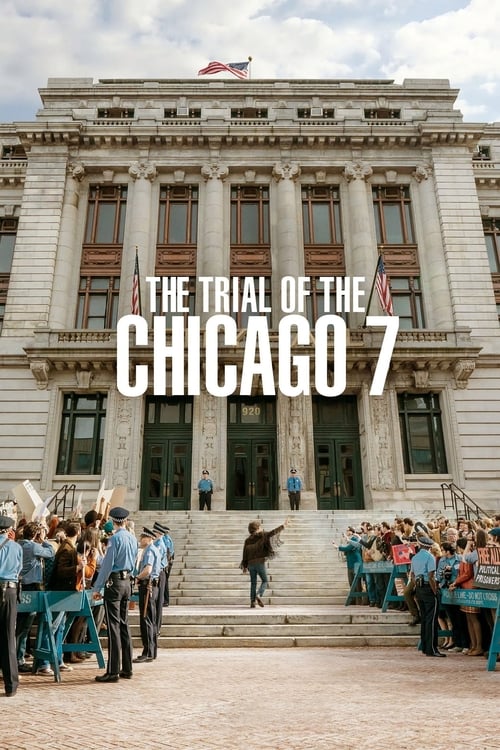
The Trial of the Chicago 7 (2020)
The Courtroom Became a Stage, and the Trial Became a Show
by 10days1movie · Published 2026-08-22
| Type | Movie |
|---|---|
| Director | Aaron Sorkin |
| Cast | Eddie Redmayne, Sacha Baron Cohen, Mark Rylance |
| Release | 2020 |
| Genre | Drama, History |
| Runtime | 130min |
The anti-war demonstration in Chicago during the 1968 Democratic National Convention; the clash with police; the trial that followed. Aaron Sorkin takes this true story and makes a film that is simultaneously a courtroom drama and a political drama. My rating is ★4.0. It is a story that overlaps with today’s world in surprisingly direct ways.
What it’s about — An anti-war protest turned conspiracy trial
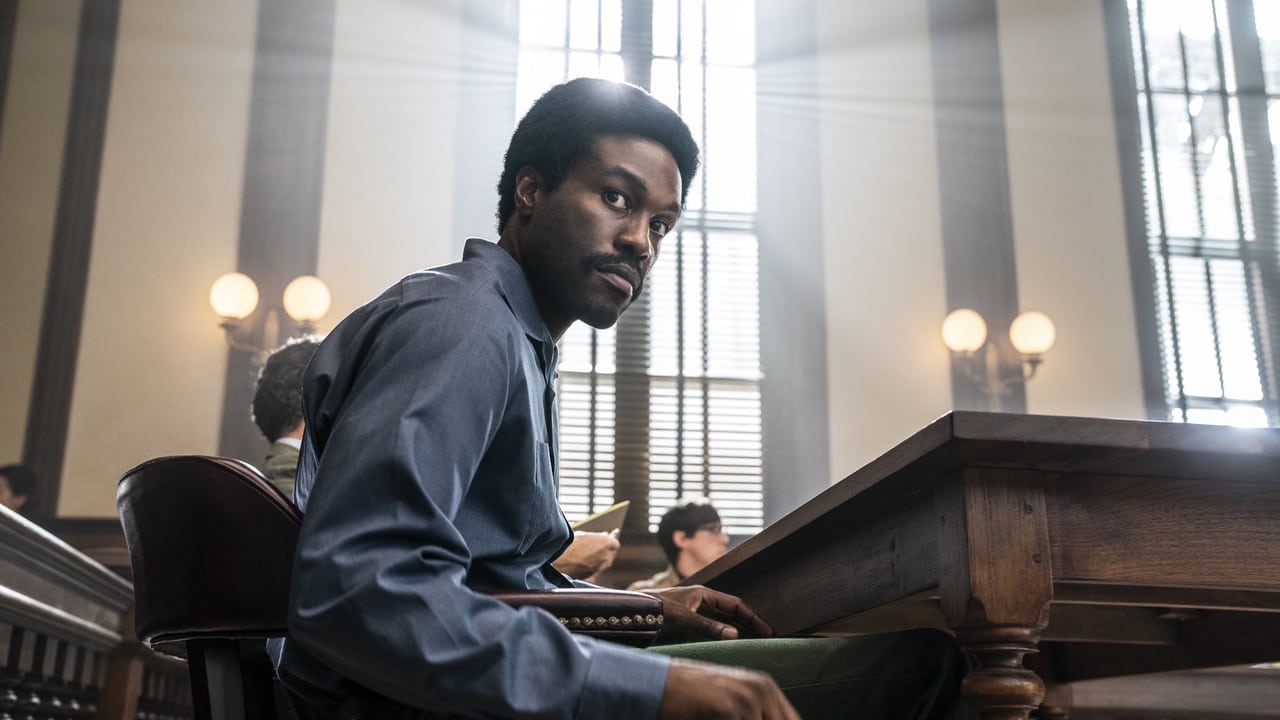
Young activists opposed to the Vietnam War gathered in Chicago in 1968. A peaceful demonstration was intended, but confrontations with police erupted, and seven men were subsequently tried on charges including conspiracy. The central material is the courtroom battle: a judge openly running the proceedings against the defense, the defense’s resistance, the defendants’ fractured strategies. The treatment of the sole Black defendant, Bobby Seale (Yahya Abdul-Mateen II), is another key thread of the trial.
Direction — A rhythm crossing between courtroom and street
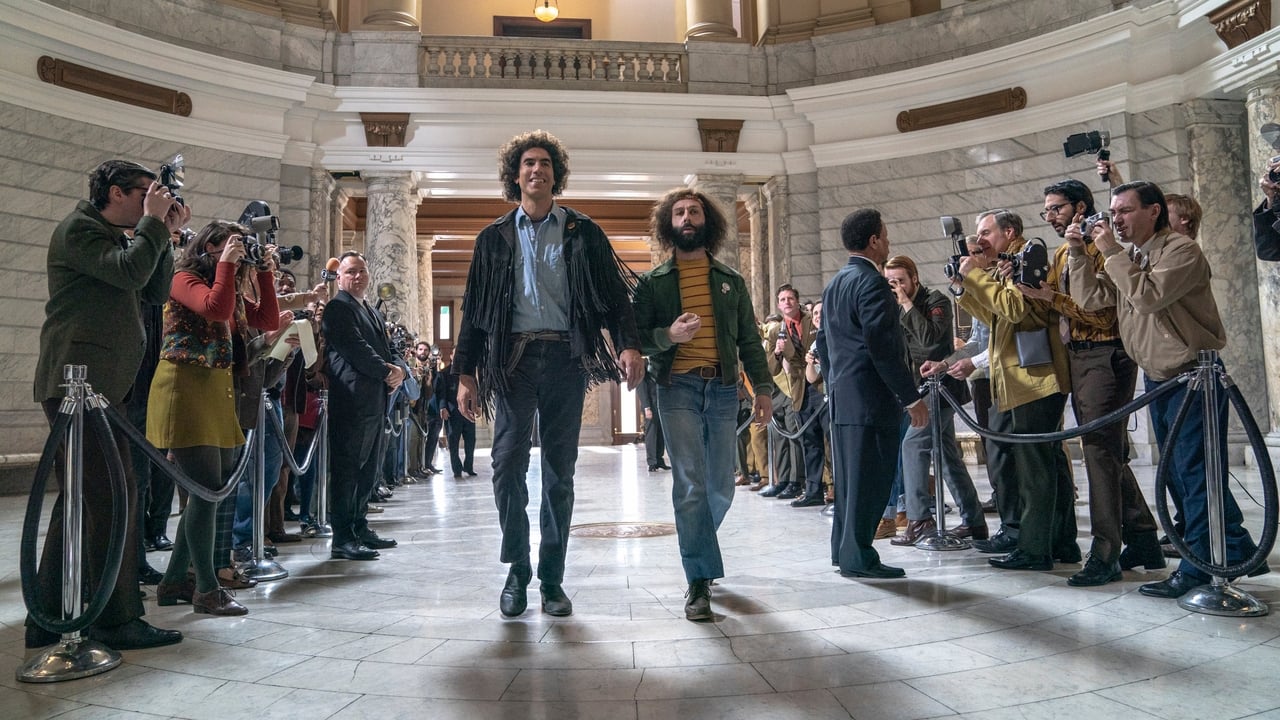
Aaron Sorkin is better known as a screenwriter, but as a director he effectively channels his dialogue-driven style into the courtroom space. The dialogue is fast and dense, with Sorkin’s characteristic rhythm very much alive. The intercutting between courtroom scenes and protest footage sharpens the irony of the trial with clarity.
Performance — Hoffman and Hayden, a clash of two resistances
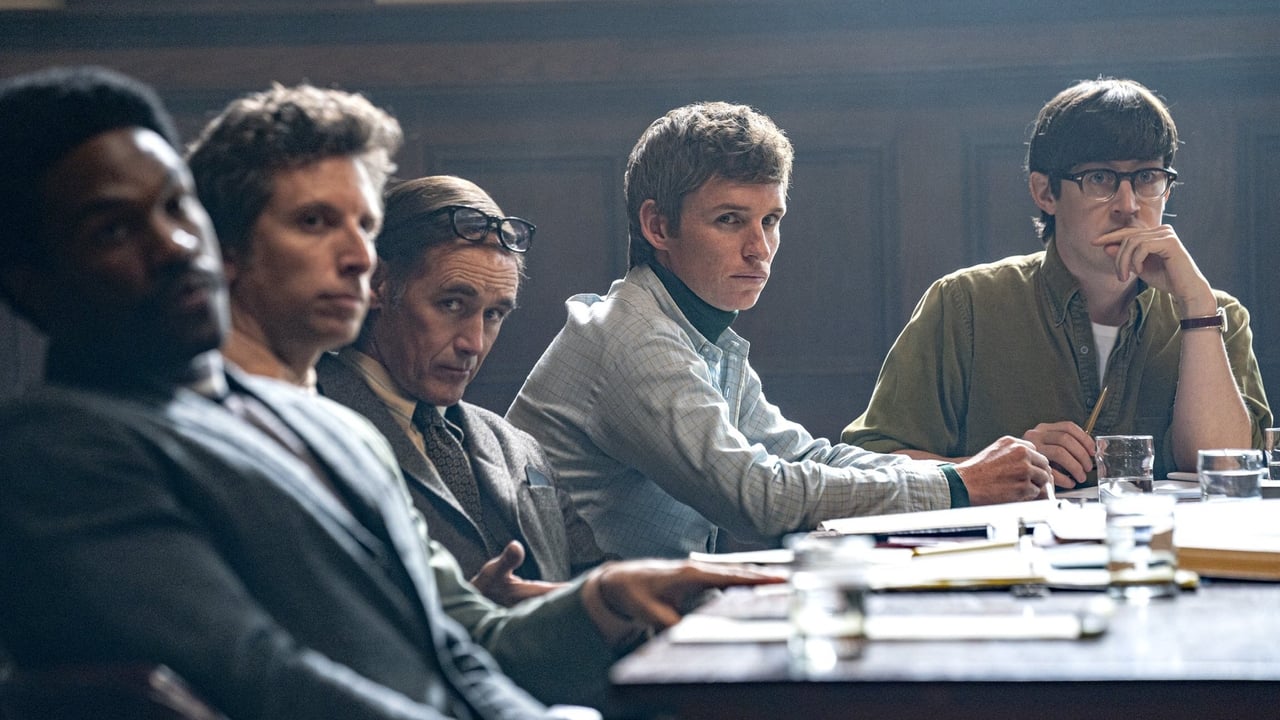
Sacha Baron Cohen’s Abbie Hoffman is the most vivid character in the entire film. His portrayal of the activist who wants to turn the trial into a show is charismatic, while revealing the seriousness behind the apparent levity — a genuinely impressive performance. Eddie Redmayne’s Tom Hayden is, by contrast, a pragmatic figure, and the clash between their two approaches creates the film’s internal conflict. Mark Rylance’s attorney William Kunstler also leaves a quiet but memorable impression.
What the film says — Law as an instrument of power, not justice
This trial was never fair. The judge is openly on the prosecution’s side, and Bobby Seale is compelled to appear in court gagged and shackled in his chair with no representation of his own. What the film depicts is a case in which the law was used not as an instrument of justice but as an instrument of power. It is a story from 1968, yet the question of how power uses institutions to suppress inconvenient voices remains entirely current.
Ratings & reception
IMDb scores it 7.7. Rotten Tomatoes gives it 89%. It received Academy Award nominations in six categories including Best Picture, Best Director, and Best Original Screenplay. Sacha Baron Cohen’s performance attracted particular attention. It was released as a Netflix original, giving it broad access, and in 2020 the American political climate amplified its resonance considerably.
What doesn’t quite work
Sorkin’s dialogue density does not suit every viewer. Although it is based on a real event, portions have been simplified for dramatic effect, and some historical details depart from the record — something history enthusiasts will notice. In consolidating a complex ideological landscape, certain characters’ positions are rendered somewhat flat. The seven defendants in real life had very different backgrounds and tactics, and the film does not fully differentiate between them. The film also tends to narrate from the defendants’ perspective, and has been criticized for not giving a fair hearing to the prosecution or the judge’s viewpoint. The Bobby Seale episode is shocking but feels somewhat unintegrated with the overall narrative. The real complexity of events is inevitably diluted by the process of dramatization for entertainment purposes.
Verdict
A film that satisfies both as a courtroom drama and as a historical film. Fast dialogue, ensemble acting, and a theme that reads as current keep the tension high for two hours. If you enjoy Sorkin’s scripts, this is a particularly enjoyable film. It’s a story from 1968, but what it says remains valid today — freedom of assembly, the abuse of state power, how to build solidarity across ideological diversity. Sorkin shows through this trial that there is a spectrum to the methods of resistance. The opposition between Abbie Hoffman and Tom Hayden symbolizes not merely a difference in personality but a strategic division within a movement, and that is what saves the film from a simple good-versus-evil framing. The greatest virtue of a real-event-based film is its ability to operate this effectively in the present.
Recommended for
- Fans of Aaron Sorkin’s scripts (The Social Network, Steve Jobs)
- Those who enjoy courtroom dramas and historical true-story films
- Those interested in the American social movements of the 1960s
Comments