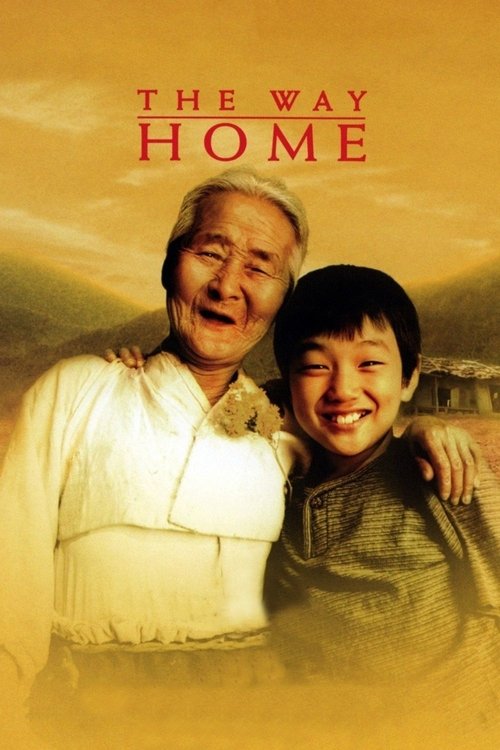
The Way Home (2002)
Wordless Love Lingers Longest
by 10days1movie · Published 2026-11-01
| Type | Movie |
|---|---|
| Director | Lee Jeong-hyang |
| Cast | Kim Eul-boon, Yoo Seung-ho, Dong Hyo-hee, Min Kyung-hoon |
| Release | 2002 |
| Genre | Drama, Family |
| Runtime | 87min |
No loud incidents, no dramatic twists. The Way Home is a film in which a seven-year-old city-raised grandson is left for a while at the mountain-village home of a grandmother who cannot speak and cannot read, and that is nearly all of it. Yet when this simple story ends, a strange heaviness settles in one corner of your chest. Films that show so clearly what love is, without once uttering the word, are rare.
What it’s about — A grandmother who cannot speak and a grandson full of complaints
Sang-woo, left with his rural grandmother due to his mother’s circumstances, is full of complaints from beginning to end. His video game does not work, there is no fried chicken, and the outhouse is scary. The boy throws tantrums at the grandmother who cannot even speak, hurls objects, and acts out. The grandmother silently takes in every bit of his sulking. With her bent back she goes to market, somehow gets whatever her grandson says he wants to eat, and when he does wrong, instead of scolding she simply watches. The film follows, without any exaggeration, the process by which these two mismatched people spend a season together and grow slowly closer.

Direction — A camera that stands one step back and trusts small gestures
Lee Jeong-hyang’s direction draws its strength from letting go of ambition. She holds back music meant to swell emotion and close-ups meant to force tears. The camera simply stands one step back and quietly captures the mountain-village scenery and the distance between the two. Thanks to that sense of distance, the audience is not spoon-fed but moves its own heart.
Instead, the director fixes her gaze, almost obsessively, on small actions. The motion of the grandmother’s hands preparing something for her grandson, each little gesture of the boy quietly opening his heart, accumulate into a great feeling. The later scene in which Sang-woo teaches his illiterate grandmother how to write letters in particular quietly proves that this film trusts a small, concrete heart over any grand lesson. The four seasons of the mountain village and the earth-scented household chores are captured realistically, adding a true-to-life weight to the story.
Performance — A non-professional actor standing not as a performer but as a presence
This film’s greatest gamble was casting an actual rural elder, not a professional actor, in the role of the grandmother. Kim Eul-boon does not so much act as simply exist in that place. Her bent back, her slow gait, the heart she conveys with gestures instead of words, come across more deeply than any masterful performance. Because nothing is dressed up, an inimitable authenticity seeps into the screen.
The child actor Yoo Seung-ho renders an easily disliked, prickly grandson in a way that is not unlikeable. Naturally moving between childish selfishness and the tender heart hidden within it, he supports the change with his grandmother so that it never feels forced. The two actors’ rapport feels less like a contest of acting skill than the very process of two people, separated by generations, coming to know each other.

What the film says — Unconditional love that asks for nothing in return
The Way Home shows what unconditional love looks like. The grandmother’s love asks for no recompense, demands no return, and does not even wait for the grandson to recognize its worth. The film does not glamorize that love but simply dissolves it into the actions of daily life. So the late scene of Sang-woo belatedly struggling to express his heart strikes all the more painfully. The size of the love we received is always guessed at only after we lose it, or after it leaves; this small film quietly tells us so.
Ratings & reception
The Way Home is a work that won great love in both domestic box office and critical reception. Its IMDb rating is a high 7.7 out of 10, its Rotten Tomatoes freshness is 75 percent, and its Metacritic score is 63 out of 100. Overseas critics especially praised the restrained direction that conveys sincerity without falling into sentimentality. It is also frequently cited as a rare case in which casting built around a non-professional actor led not to awkwardness but to authenticity.

Verdict
To eyes accustomed to quick stimulation, The Way Home may feel somewhat plain. But to those who endure its slow rhythm, it offers a long-lingering afterimage. Considering how rare it is for a film to move the heart through sincerity alone, with no flourish, this plainness is a virtue in itself. My rating is ★4.0. It is a work you return to when, before the word family, you want to grow a little solemn.
Recommended for
- Viewers who love films that leave a deep resonance without sensational developments
- Those who want to feel the true-to-life emotion that unadorned acting brings
- Anyone who wants to recall the grandparent generation and quietly look into their own heart
Comments